

What is the Google advertising network?
The advertising network is, in practice, a vast network comprising over 2 million websites, applications, and videos where you can display your ads to a wide audience. In other words, the advertising network covers a significant portion of sites available in Google search, YouTube, Gmail, as well as various applications and online games. This means that ads can appear on various types of websites, including informational, lifestyle, blogs, and social media-related sites. Undoubtedly, website positioning and advertising in the Google advertising network constitute an excellent combination of advertising activities. Moreover, the Google advertising network offers rich possibilities for presenting advertising messages:

Text Ads
similar to advertising directly in Google search results, so-called Sponsored Links in Google’s partner network;

Display Ads
these are banners displayed in the space provided by websites and applications belonging to Google’s partner network; graphics can be prepared independently, using the flexibility to customize banners in terms of dimensions, appearance, etc., or commissioned to a professional graphic designer to prepare banners for a specific campaign;

Multimedia Ads
video ads or those using animation.
A distinguishing feature of promotion in the advertising network is undoubtedly the extensive ability to target ads, i.e., displaying advertising messages based on pre-set criteria. The advertising network allows for the presentation of targeted advertising messages based on:
- Keywords – also known as contextual targeting – is an effective way to increase the conversion rate from GDN advertising, as the ad is matched in content to the content of the website on which it is displayed. Contextual targeting involves setting keywords in the Google Ads system that correspond to the advertiser’s business profile. The system will automatically select target locations related to the chosen phrases.
- Topics – targeting ads to topics means displaying advertising messages on websites related to selected topics. Google allows targeting the following subjects:
- Home and Garden,
- Encyclopedias and Dictionaries,
- Finance,
- Games,
- Hobbies and Leisure,
- Internet and Telecommunications,
- Computers and Electronics,
- Books and Literature,
- People and Society,
- World Places,
- Science,
- Real Estate,
- Beauty and Fitness,
- Travel,
- Jobs and Education,
- Law and Government,
- Autos and Vehicles,
- Sports,
- Online Communities,
- Arts and Entertainment,
- Business and Industrial Services,
- News,
- Shopping,
- Health,
- Pets and Animals,
- Food and Drink.
Some categories have additional narrowing options. This allows for an even more precise selection of groups of websites where ads will be displayed.
- Audiences with similar plans – Internet users’ behaviors are no secret to Google. If they share their plans online – searching for housing offers for sale, travel, browsing store pages with specific assortments, etc., Google allows displaying an advertising message to them regardless of the currently displayed content. The division of users in this aspect is as follows:
- Event and Ticket Sales,
- Home and Garden,
- Education,
- Consumer Electronics,
- Computers and Peripherals,
- Real Estate,
- Apparel and Accessories,
- Software,
- Travel,
- Baby and Children’s Products
- Beauty Products and Services,
- Autos and Vehicles,
- Sports and Fitness,
- Telecommunications,
- Gifts and Occasions,
- Business Services,
- Financial Services,
- Dating Services,
- Employment.
- Audiences who have interacted with the site – this form of targeting is reserved for so-called Remarketing. It involves displaying ads to users who have visited the advertiser’s site and performed a specific action – did not make any conversion, abandoned a purchase after adding a product to the cart, made a purchase, spent a certain amount of time on the site, etc. Remarketing allows “reminding” users, encouraging them to return and make further purchases, offer a discount, etc.
- Placements – in case the advertiser has a defined group of websites or places on the Internet where they would like to display their ad banners, it is enough to choose targeting for placements and precisely determine the places where the ad will be displayed. Advertisers can choose from websites, YouTube channels, individual videos, as well as categories and specific web applications.
- Demographics – depending on the adopted strategy and the type of products or services, specifying the demographic details of the ad recipients gains importance. Within Google Display Network, it is possible to target an advertising campaign to people with specific demographic data, such as:
- Gender
- With or without children.
By using demographic targeting, it’s easy to specify which ad creative will reach specific groups of people.
The advertising network is thus an excellent place to promote products and services of virtually any type. The extensive possibilities of reaching new potential customers and rich forms of promotional messaging allow for effectively reaching users from different audience groups. There is no doubt that combining different forms of advertising – SEO and Google Ads advertising network – will yield even better results. Take advantage of the knowledge, experience, and skills of specialists from Upseo.net Agency and achieve more on the Internet!
GDN advertising works best for clients who are in the early stages of the sales funnel, i.e., at the stage of building brand awareness and generating interest. However, this does not mean that the advertising message will not reach users who are more determined to make a purchase. Thanks to GDN, you can reach a huge group of potential customers browsing over two million websites, videos, or applications that make their space available for advertising purposes. Can you afford to miss such a huge opportunity to reach customers?
Types of GDN advertising
Effective GDN (Google Display Network) advertising can take various forms of advertising messages. Each of them brings many benefits to the advertiser. Among the most popular forms of display advertising in the Google Ads network, one can undoubtedly distinguish:
Responsive Display Ads
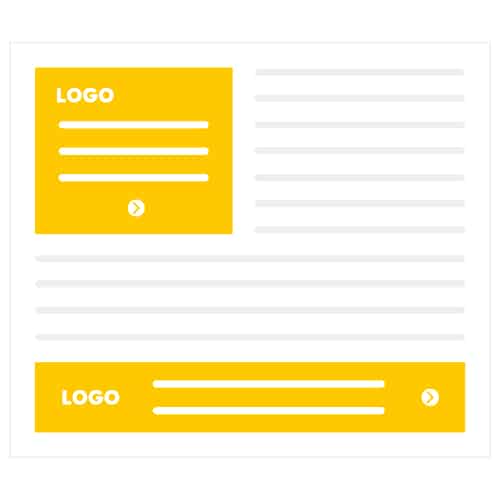
this has been the default type of campaign in the advertising network since 2018. The essential feature of this type of advertising is the automation of its creation. It is enough to add basic elements of the advertising message to the advertising account (logo, at least 1 image, and several variants of advertising text), and the system will automatically combine the given elements and adapt the message to the expectations of the recipient. This is a convenient and effective way to increase the relevance of matching the advertising message to defined audience groups. Moreover, banners created in the form of responsive display ads allow for reducing the costs of creating dedicated graphics.
Remarketing
this is an extremely interesting and effective way to reach customers who have already visited the advertiser’s website but have not made any interaction. Thanks to remarketing, you can “remind” undecided users about the offer. For users who have shown interest but have not made a purchase, it is possible to prepare, for example, a special discount or rebate for the purchase.

Static Display Ads
it may happen that the advertiser’s expectations regarding graphics presenting products or services are precisely specified. Google does not leave users with their own expectations regarding the appearance of graphics without help and allows adding their own graphic creations to the GDN campaign. Static banners uploaded to the Google Ads system should be saved in one of the popular graphic formats – JPG, PNG, GIF, or HTML5 in formats compliant with system requirements.

Lightbox Ads
a specific form of display advertising with an expandable form. Placing a lightbox ad on a website allows displaying the ad on the entire screen, enabling transition to the advertiser’s website. The lightbox ad responds to clicking, hovering with the cursor or finger, and is displayed for at least 3 seconds.

Dynamic Remarketing
functions essentially similar to its standard version, but is directed exclusively at online stores. The ads here are products that “follow” the undecided customer, which they did not buy in the visited online store.

Depending on the adopted marketing strategy, each advertiser within Google Ads has the opportunity to take advantage of the mentioned rich possibilities of reaching potential or undecided customers. There is nothing to prevent using several types of advertising simultaneously to increase the number of potential customers and the effectiveness of advertising activities.
GDN campaign settlements
GDN campaigns are a very effective support for marketing strategies in the context of building image and brand recognition. They are also effective from a sales perspective. In this context, depending on the set goals, different methods of campaign settlements can be adopted:
- Settlements in the CPM (Cost Per Mile) model – a model used in strategies focused on promoting a new brand or building awareness among new potential recipients. CPM means the cost per thousand impressions. In this model, the Google Ads system chooses ad placements in places with potentially the greatest opportunities to reach new customers. The cost of 1,000 impressions can range from a few dozen cents to several zlotys.
- Settlements in the CPC (Cost Per Click) model – payment for a single click on an ad – a model used in campaigns aimed at clicks, thus encouraging visits to the linked page in the ad. This type of settlement is most effective for campaigns aimed at acquiring leads (email or phone), filling out forms, or making purchases.
GDN campaigns at the Upseo SEO/SEM Internet marketing agency are settled according to the model resulting from the advertiser’s strategy. The SEO pricing does not allow for precise determination of campaign costs without detailed analysis, however, in the case of Google Ads campaigns, we apply clear and precise settlements:
for a budget up to 3,000 PLN => 690 PLN
for a budget over 3,000 PLN => 690 PLN + 15% x (Your budget – 3,000 PLN)

